

An Unprecedented Urban Transformation Redefining the Emirate’s Future
Dubai is preparing to undergo the most ambitious transformation in its history. With the Urban Master Plan 2040, launched in March 2021 by His Highness Sheikh Mohammed bin Rashid Al Maktoum, the emirate unveils a bold vision that will place humanity and sustainability at the heart of its development for the next two decades.

An Urban Ecological Revolution
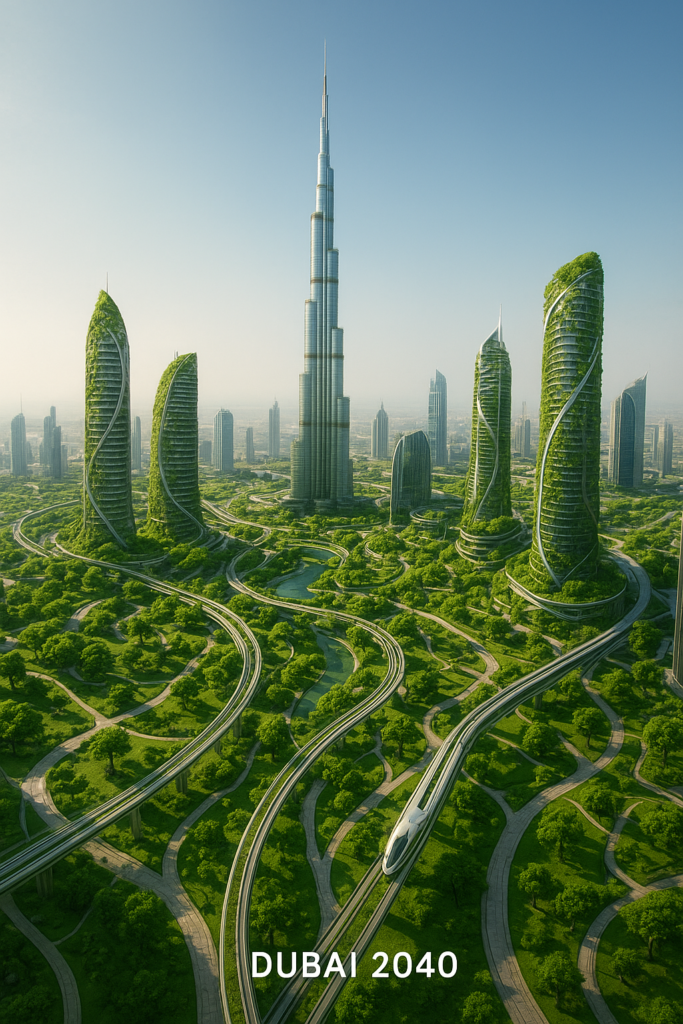
The most spectacular aspect of this transformation lies in Dubai’s environmental commitment. The plan aims to double green and recreational spaces, radically transforming the face of a city long associated with skyscrapers and concrete. Public parks will be strategically redistributed to serve a growing population, creating a network of green lungs throughout the emirate.
Even more ambitious, natural reserves and rural natural areas will constitute 60% of the emirate’s total area. This unprecedented initiative positions Dubai as a regional leader in urban environmental conservation. Green corridors will be established to connect service areas, residential neighborhoods, and workplaces, facilitating pedestrian, cycling, and sustainable mobility.
Quadrupled Coastline: A New Coastal Lifestyle
The transformation of the coastline constitutes one of the plan’s most impressive pillars. The length of public beaches will increase by 400%, from 21 kilometers to 105 kilometers by 2040. This massive expansion will offer residents and visitors unprecedented access to the emirate’s coasts, strengthening Dubai’s maritime identity and democratizing access to beach areas.
This multiplication of public beaches responds to growing demand for quality leisure spaces and will significantly contribute to improving residents’ quality of life.
The Post-Automobile Era: Towards Human Mobility
Dubai is resolutely committing to a transition toward sustainable, human-centered mobility. The plan aims to encourage the use of public transportation, walking, cycling, and flexible means of transport. The goal is ambitious: ensure that 55 to 80% of the population lives within walking distance of a major public transport station, according to the “20-minute city” concept.
This mobility revolution will be accompanied by massive development of pedestrian and cycling infrastructure, with dedicated lanes and shaded pedestrian zones. The emphasis will be on reducing car dependency, creating more connected and livable communities where residents can access their daily needs without a car.

A Metropolis of 8 Million Inhabitants
Dubai’s population is expected to grow from 4 million currently to approximately 7.8 million by 2040, consolidating the emirate’s position as one of the world’s most dynamic and diverse destinations. To support this demographic growth, the plan envisions the development of five major urban centers, including three existing ones (Deira/Bur Dubai, Downtown/Business Bay, Dubai Marina/JBR) and two new ones (Expo City and Dubai Silicon Oasis).
This expansion will be accompanied by massive investment in social infrastructure, with a 25% increase in area dedicated to educational and healthcare facilities. The government has also allocated 65 billion dirhams to create 17,000 new affordable housing units for citizens, ensuring inclusive growth.
Integrated and Sustainable Communities
The 2040 Master Plan emphasizes the development of integrated communities, designed according to the highest planning standards. These new neighborhoods will combine green spaces, shopping centers, and recreational facilities, all oriented toward human well-being and accessibility.
The approach prioritizes the development of mixed-use zones where residents, businesses, and workplaces coexist harmoniously, reducing travel times and strengthening social fabric. Developers and government departments will work in coordination to create these green corridors connecting different areas of the city.
A Model of Sustainable Development
This transformation is not limited to physical expansion. Dubai aims to become a global model of sustainable urban development, integrating smart city technologies and cutting-edge environmental practices. The emirate aims to reduce its carbon footprint, improve air quality, and create urban spaces resilient to climate change.
The 134% increase in area dedicated to hotel and tourism activities, as well as the expansion to 168 square kilometers of commercial zones, demonstrates the economic ambition accompanying this ecological transformation.
A Vision Taking Shape
With the launch of Phase II of the plan in 2022, following the successful evaluation of 17 Phase I projects, Dubai demonstrates its commitment to realizing this vision. Rigorous monitoring systems ensure the measurement of impact and effectiveness of initiatives, while a centralized urban planning database supports real-time tracking.
The Dubai Urban Master Plan 2040 represents much more than a simple urban planning project: it’s a complete redefinition of what a 21st-century metropolis can be. By placing nature, sustainable mobility, and human well-being at the center of its strategy, Dubai is charting a new path for the cities of the future, proving that economic ambition and environmental responsibility can not only coexist but mutually reinforce each other.